
On a first date, the usual rule is that the person who asked pays. Many people still expect the man to pay on a first date between a man and a woman, so the safest move for either person is to offer, and to accept a polite no. After the first few dates, most couples take turns or split the bill. If you split, you can split it evenly or by what each of you had; the restaurant bill calculator works out both to the cent.
Who should pay on a first date?
The rule etiquette experts give most often is simple: whoever extends the invitation pays, tip included. An etiquette expert quoted by CBS News puts it exactly that way. It works for any couple, because it depends on who asked, not on gender.
Surveys show that many people still expect something else between a man and a woman:
- In a NerdWallet survey of 2,061 U.S. adults, run by The Harris Poll in December 2023, 72% agreed that the man should pay on the first date in a heterosexual couple: 78% of men and 68% of women.
- In the same survey, 65% agreed that whoever asked the other out should pay. Here the gap runs the other way: 77% of women agreed, but only 52% of men.
- A LendingTree survey of 1,578 U.S. adults in August 2022, which asked people to pick one answer, found 44% for “the man pays”, 29% for “the person who asked” and 22% for “split it”. Gen Z was the most likely generation to choose the person who asked (34%) or a split (32%).
So two people on the same date can expect different things. That is why offering matters more than any single rule.
| Situation | Who usually pays |
|---|---|
| You asked them out | You, and they offer to pay their share |
| They asked you out | They do; you offer anyway |
| You planned it together | Split it, or one pays now and the other pays next time |
| One of you chose an expensive place | The one who chose it |
| You’ve been dating for a while | Take turns, split, or the one who earns more pays more often |
Who pays after the first date?
After the first date or two, most couples move to one of three habits:
- Take turns. One pays this time, the other next time. A personal finance adviser quoted by Bumble suggests the one who chooses the place pays, and you take turns choosing.
- Split the bill. Evenly, or by what each of you had when one person orders much more.
- The one who earns more pays more often. In the NerdWallet survey, 57% agreed that the person who makes more money should pay for dates more often.
None of these is wrong. What causes trouble is one person assuming one habit and the other assuming another. Once you share regular costs as a couple, such as rent or groceries, the rent and bills by income calculator shows what each of you pays when you split by income instead of 50/50.
How to offer to pay, and how to accept or say no
Offer when the bill arrives, and mean it. A few lines that work:
- If you asked: “I invited you, so this one’s on me.”
- If they asked: “Can I pay my half?” If they say no: “Thank you, that’s kind. The next one’s on me.”
- If you want to split: “Shall we split it?” Saying it lightly, before the card comes out, avoids an awkward tug of war over the bill.
- If they insist on paying and you would rather not let them: “I’d really like to pay my share.” Then leave it there; a second refusal is an answer.
If one of you pays the whole bill and the other wants to pay their share back afterwards, say so at the table and send it the same day. Our guide on asking someone to pay you back has messages you can copy for the other side of that.
How to split the bill on a date, step by step
Alex asked Sam to dinner. They share a burrata (12.00 USD) and a tiramisu (9.00). Alex has a steak (34.00) and two glasses of wine (22.00); Sam has a risotto (21.00) and a sparkling water (4.00). Food and drink come to 102.00 USD, and they add an 18.00 tip, for 120.00 in all.
- Split the shared dishes. 12.00 + 9.00 = 21.00, so 10.50 each.
- Add what each person had alone. Alex: 34.00 + 22.00 + 10.50 = 66.50. Sam: 21.00 + 4.00 + 10.50 = 35.50.
- Share the tip by what each had. Alex had 66.50 of the 102.00, so pays 18.00 × 66.50 ÷ 102.00 = 11.74 of the tip; Sam pays 6.26.
- Add it up. Alex pays 66.50 + 11.74 = 78.24 USD and Sam 35.50 + 6.26 = 41.76 USD, which together make exactly 120.00.
| How they pay | Alex | Sam |
|---|---|---|
| The one who asked pays | 120.00 | 0.00 |
| Split evenly | 60.00 | 60.00 |
| By what each had | 78.24 | 41.76 |
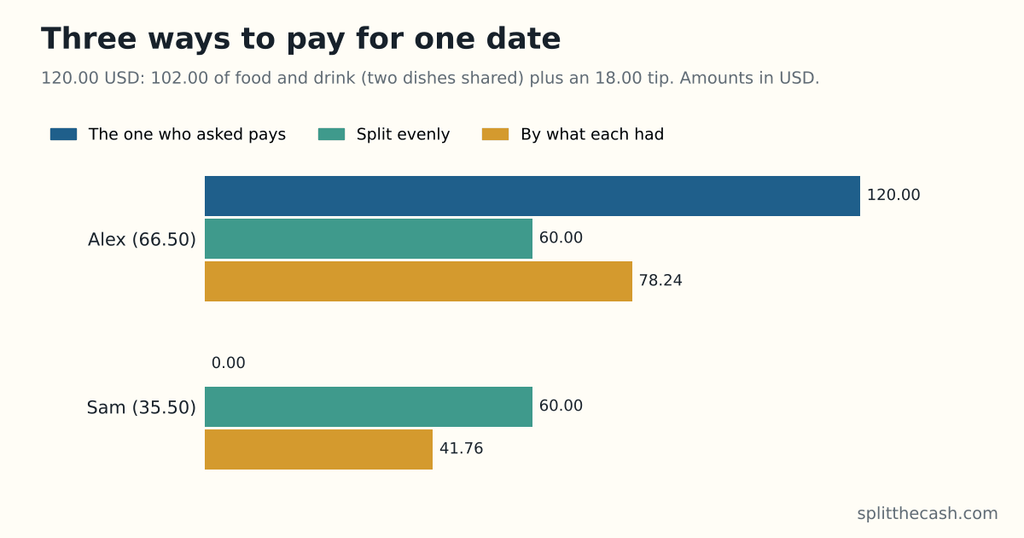
Split evenly, Sam pays 18.24 USD more than by what each had, mostly for Alex’s steak and wine. On one dinner that may not matter. When one person orders much more as a habit, splitting by what each had is fairer.
Try it with your own bill
Change the names, dishes and prices. For anything you shared, tap neither name, and it is split between you. If tax is added on top of the prices, enter it as a percentage: it is shared the same way as the tip. To split the whole bill evenly instead, the equal split calculator divides any amount to the cent.
Dating and money: a few habits that help
- Say who’s paying when you invite. “Let me take you to dinner” and “Want to grab dinner?” mean different things to different people. A few words in the invitation remove the guessing.
- Pick a place both of you can afford. If the other person pays their share, an expensive choice becomes their bill too.
- Don’t forget the tip. Whoever pays the bill pays the tip, or you split it the same way as the bill.
- Talk about it once it becomes a pattern. If one of you always pays, or you earn very different amounts, agree on a habit rather than settling it at every bill.
Common questions
Is it rude to split the bill on a first date?
No. Splitting is a normal choice, and in the LendingTree survey about a third of Gen Z picked it as the right answer for a first date. Suggest it kindly, before the card comes out. If the person who asked you out wants to pay, letting them is also fine.
Should I offer to pay if they asked me out?
Yes. Offer to pay your share, and if they say no, thank them and offer to get the next one. Offering shows you didn’t assume they would pay.
Should a guy always pay for a date?
There’s no rule that he must. Many people still expect the man to pay on a first date: 72% in the NerdWallet survey. Fewer expect it to go on for every date, and splitting or taking turns is common once you’ve been out a few times. If you are the one who usually pays and you’d like to share, say so; if you’re the one being paid for, offer.
When should a woman start paying for dates?
Offering can start on the first date. Paying often starts when she does the asking, chooses the place, or after the first few dates when the couple starts taking turns. There’s no fixed date number; the habit you agree on matters more than who pays which time.
Who pays on the second date?
Often the one who didn’t pay the first time, or the one who asked again. Many couples take turns from here, or split.
What if one of us earns much more?
Then the higher earner may pay more often, or choose places the other can afford. More than half of Americans in the NerdWallet survey agreed with paying more often in that case. In a longer relationship, couples often split shared costs by income; the rent and bills by income calculator shows how.
I only had a salad. Do we still split it evenly?
You don’t have to. Split by what each person had: shared dishes in half, the rest to whoever ordered it, and the tip in the same proportion. The restaurant bill calculator does this item by item.
Who pays the tip?
Whoever pays the bill. If you split the bill, split the tip the same way: evenly, or by what each person had, as in the example above.