
Your friend had no cash, so you paid. “I’ll send it tonight,” they said. That was three weeks ago. The amount is too small to make a fuss about and just big enough to annoy you every time you see them order a dessert. If you’re too shy to ask, this guide is for you: how to stop it happening at the table, reminder texts to copy, and what to do with the friend whose wallet is always in the other jacket.
Why it feels so awkward to ask
Asking for money back can feel petty, as if you’re putting a price on the friendship. But you aren’t the one who made it about money: the unpaid amount did. Often your friend has simply forgotten, and a clear reminder helps them as much as you. The longer you wait, the bigger the moment gets, so the easiest time to ask is right away.
The easiest fix: settle it before you leave the table
Most “pay you back later” debts are forgotten, not refused. So write it down while everyone is still there, in a message everyone can see. In the restaurant bill calculator, open “Collect payments” under the result. When you pay for a friend, tap “Also paying for a friend”, choose who, and how much: all of their share or part of it. “Who owes whom” then shows a line like “Anna owes Ben 37.00 EUR”, which you can send to the group by WhatsApp, Telegram, email or text in one tap.
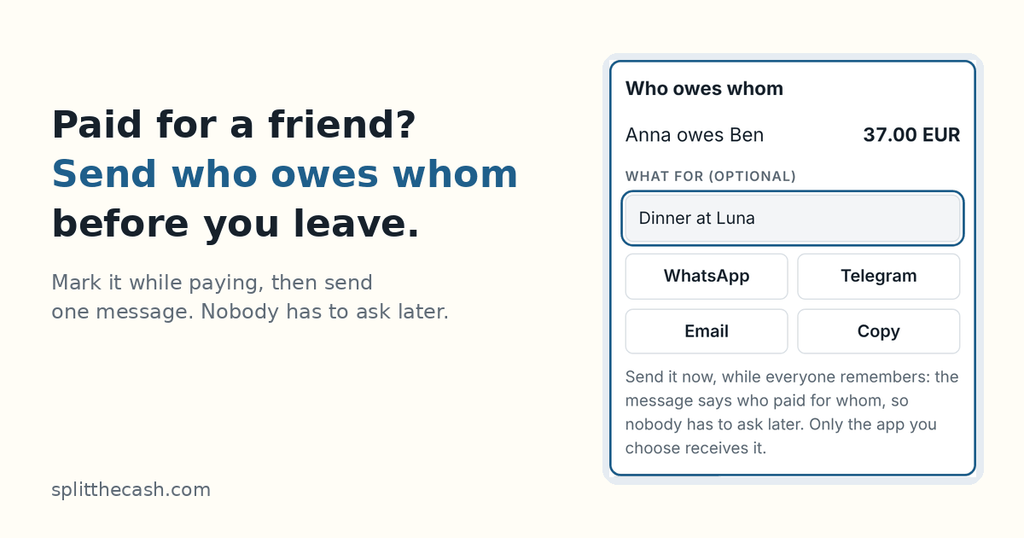
It works because the message comes from the bill, not from you. Nobody has to say “you owe me”: the numbers say it, and your friend has the exact amount in their chat for when they get home. For a trip or a weekend where several people paid for different things, the settle-up calculator works out who sends what to whom.
How to ask a friend to pay you back politely: texts to copy
Start light and get firmer only if you need to. Always say the exact amount and what it was for, so there is nothing to work out or remember.
The same evening
Great night! Your part of dinner came to 37 EUR. Send it whenever you get home.
A few days later: the gentle nudge
Hey, quick one before I forget: the 37 EUR from Friday’s dinner. No stress, just tidying up my month.
Make it easy: add a date and a way to pay
Hi Anna, could you send the 37 EUR from dinner by Sunday? Here’s my payment link, so it takes ten seconds.
Direct, still friendly
Anna, I’ve mentioned the 37 EUR a couple of times now. I’d like to get it sorted this week. Can you send it, or tell me when you can?
If money is tight for them
If it’s a tight month, no problem. Would 10 EUR a week work until it’s done?
Text is fine for all of these. It gives your friend time to answer without being put on the spot, and the amount is there in writing. Keep the tone the same as your other messages to them: a sudden formal note reads like a lawyer’s letter.
Send a payment request instead of a reminder
Many payment apps have a request button: you enter the amount, and your friend gets a request they can pay with one tap. It turns “please remember” into “please tap”. For example, PayPal lets you share a request link by text or chat; the other person needs a PayPal account (PayPal). Revolut lets you create a payment link from the Payments tab (Revolut Help). Check what your own bank or app offers.
When a friend never pays you back
Some people are not forgetful once; they are forgetful as a lifestyle. If it keeps happening with the same friend:
- Stop being the bank. Next time, say before ordering: “I’ve only got enough for me tonight.” You don’t owe anyone an explanation.
- Split at the table, every time. Ask for separate bills, or have each person pay their own share before anyone leaves.
- Talk about the pattern, not the 37 EUR. “It’s not about this one dinner. It keeps happening, and it’s starting to bother me.” That is easier to hear than a list of dates.
- Decide what it’s worth. For a small amount, you can choose to let it go and simply not lend again. That’s a decision, not a defeat.
For a larger amount, keep a written record: the date, the amount, what it was for and any messages where your friend agreed to pay. If nothing else works, a court may be the last step. In England and Wales, for example, the small claims process usually covers amounts up to £10,000, and you are expected to send a “letter before claim” first, usually giving 14 days to pay (Legal Choices). Rules and limits differ by country and US state; this is general information, not legal advice.
Common questions
Is it rude to ask a friend for money back?
No. They agreed to pay, and a reminder with the exact amount is a favour to someone who forgot. What makes it feel rude is waiting so long that the reminder becomes a confrontation.
How long should I wait before reminding them?
Mention it the same day, then remind them after a few days if nothing arrives. Waiting a month makes it harder for both of you.
How do I remind someone they owe me money by text?
Keep it short: the amount, what it was for, and an easy way to pay, such as a payment link. Use the examples above and change the names and the amount.
My friend owes me money and is avoiding me. What can I do?
Send one clear message with the amount and a date, and offer a payment plan in case money is the problem. If there is still no answer, decide whether the amount is worth chasing. For a large sum, keep the messages as a record and look up how small claims work where you live.
Can I sue a friend who owes me money?
In many places, yes, through a small claims court, usually after sending a formal letter first. It costs time and often the friendship, so it is a last step for amounts that matter. See the section above for an example of how it works in England and Wales.