
A joint birthday party is one party for two or more people whose birthdays fall close together: siblings, cousins, or friends from the same class. It halves the planning and often the cost, but only if the families agree on a few things before anything is booked: the guest list, the budget, gifts and how the bill is split. This guide covers each, with invitation wording you can copy and a joint party cost calculator for the money.
Is a joint birthday party a good idea?
It works well when the children share most of their friends, are close in age and are happy to share the day. It is harder when the guest lists barely overlap, when one child is much older, or when one family wants a much bigger party than the other. Ask the children first: some love a big shared party, others want a day that is only theirs.
What to agree before you book
- Date, place and time. Pick a date between the two birthdays, or the weekend nearest to both.
- Guest list. Who invites whom, the total number of guests, and whether siblings of guests are welcome.
- Budget and how to split it. A total you both accept, and which of the three methods below you will use.
- Cake. One cake with both names, or one cake each, so each child gets their own song and candles.
- Gifts. What the invitation will say about gifts (see below).
- Who does what. Who books, who pays the deposit, who buys the party bags, who sends the invitations and who collects replies.
Who pays for a joint birthday party?
For siblings, the parents pay as they would for any party. When two families share a party, each family usually pays its part. There are three common ways to work out that part:
- Equal split. Each family pays half. Simple, and fair when both families invite about the same number of guests.
- Shared costs equal, food by guests. Costs that stay the same however many children come (venue, entertainer, cake, decorations) are split equally. Costs per child (food, drinks, party bags) follow how many guests each family invited.
- Everything by guests. The whole bill follows each family’s number of guests.
Children who are friends of both are split between the families. The second method is usually the fairest when the guest lists differ: both children get a party, and each family pays for the guests it chose.
Worked example: 750 USD between two families
Ava and Noah have a joint party. The venue costs 240, the cake 60 and the decorations 60, so the shared costs are 360 USD. Food and a party bag cost 15 USD a child. Ava’s family invited 12 children, Noah’s family 6, and 8 children are friends of both, 26 guests in all. The party costs 360 + 26 × 15 = 750 USD.
| Method | Ava’s family | Noah’s family |
|---|---|---|
| Equal split | 375.00 | 375.00 |
| Shared equal, food by guests | 420.00 | 330.00 |
| Everything by guests | 461.54 | 288.46 |
With the second method, each family pays 180 of the shared costs. Ava’s family has 12 + 4 = 16 guests (its own plus half of the friends of both), so 16 × 15 = 240 for food; Noah’s family has 6 + 4 = 10, so 150. Split equally, Noah’s family would pay 45 towards guests Ava’s family invited.
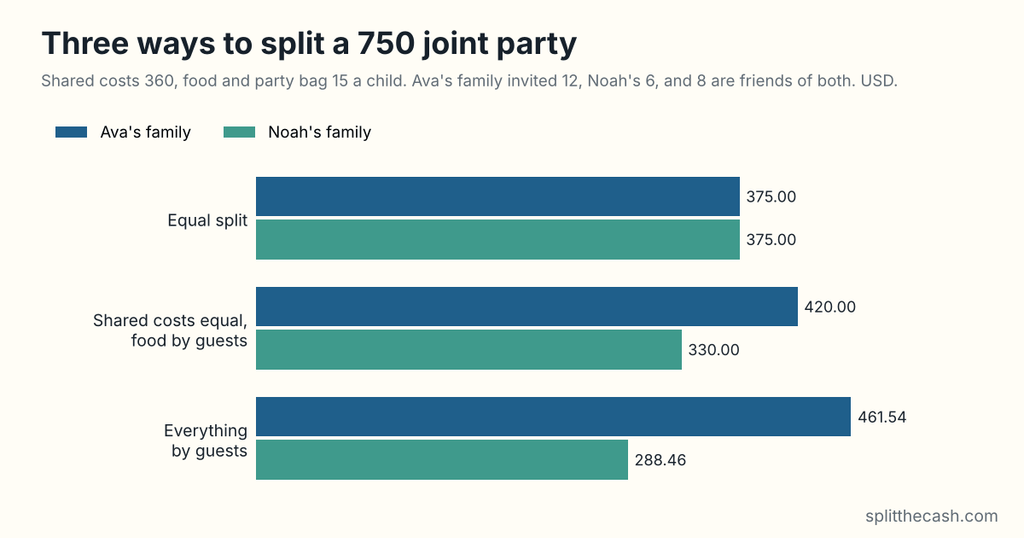
Try it with your own party. To split everything by guests, change “Split the shared costs” to “By number of guests”.
How to word a joint birthday party invitation
Name both children, say it is a joint party, and give the date, time, place, how to reply and anything about gifts. Three examples to adapt:
Ava is turning 7 and Noah is turning 6! Join us for a joint birthday party on Saturday 13 March, 2–4 pm, at Riverside Play Centre. Please reply to Sarah by 6 March.
Two birthdays, one party! Lily and Max invite you to celebrate with them on Sunday 2 May, 11 am – 1 pm, at 12 Oak Road. Your company is the only gift they need.
Double the cake, double the fun. Join us for Mia and Sam’s joint birthday party on Saturday 19 June, 3–5 pm, at the park pavilion. If you’d like to bring a gift, one small present for the child you know is plenty.
Send one invitation from both families, so guests who know both children aren’t left wondering whether they were invited twice.
Joint birthday party gift etiquette
Guests’ main question is whether to bring one gift or two. Say it on the invitation, so nobody has to guess. Common choices:
- No gifts. The simplest for everyone, and it avoids one child getting more than the other.
- One gift for the child you know. Guests who know both can bring something small for each.
- A gift fund. Guests put in what they like towards one present per child, for example a bigger toy or an outing. The group gift calculator works out each person’s part if a group buys together.
Open presents after the party rather than in front of everyone, so the children’s piles aren’t compared.
Common questions
What does “joint birthday party” mean?
One party that celebrates two or more people’s birthdays together, with guests invited by both. It is common for siblings, twins, cousins and friends whose birthdays are close.
Who should pay for a birthday party?
Usually whoever hosts it: the parents for a child’s party. For a joint party, the host families share the cost by one of the three methods above. For a birthday meal at a restaurant, see who pays at a birthday dinner.
What if one family wants extras?
That family pays for them: a second entertainer, a bigger cake or a present for its own child. Keep them out of the shared bill.
How do you split the cost when one family paid the deposit?
Work out each family’s share of the whole party first, then take off what each has already paid. The difference is what one family sends the other. The calculator shows each family’s share; the settle-up calculator works out who sends what when several people paid for different things.
Does this work for adults?
Yes. Friends or couples who share a party can use the same methods: the venue or table split equally, food and drinks by each person’s guests.