
Who pays at a birthday dinner depends on who did the inviting. If the birthday person invites everyone, they are the host and usually pay. If friends organise the dinner to celebrate them, the friends usually split the bill and cover the birthday person’s share. Agree on which it is before anyone orders, then use the restaurant bill calculator to work out each share to the cent.
Who usually pays for a birthday dinner?
The person who invites usually pays. Etiquette experts quoted in a U.S. News article (republished by WTOP) agree on one rule of thumb: whoever hosts, pays. That holds whether the host is the birthday person or a friend throwing the dinner for them.
Most birthday dinners are less formal than that. A group of friends meets at a restaurant to celebrate someone, and nobody is really the host. In that case the usual answer is that everyone except the birthday person splits the bill. Daily Meal calls this the most agreeable way to handle it, and the etiquette consultant Diane Gottsman says it is common to pay for your own meal and part of the birthday person’s.
| Who invited? | Who usually pays |
|---|---|
| The birthday person (“Come to my birthday dinner”) | The birthday person, as host |
| A friend or partner hosting (“I’m taking Maya out, join us”) | The host, for everyone |
| The group, together (“Let’s all celebrate Maya”) | Everyone except the birthday person, who is treated |
| Anyone, with the plan stated (“We’re splitting the bill”) | As stated in the invitation |
Does the birthday person pay for their own dinner?
Usually not, when friends organise the dinner. Patricia Napier-Fitzpatrick of The Etiquette School of New York, quoted by Daily Meal, says that when the friends suggest getting together to celebrate someone, everyone except the birthday person pays.
It changes when the birthday person sets up the dinner themselves and invites people to it. Then they are the host, and the same expert says they would pay for everyone, while the guests bring a gift. Daily Meal adds that picking an expensive place and expecting friends to cover you does not fit that role.
If the birthday person is part of a couple, groups handle the partner differently. Some treat only the birthday person; The Art of Manliness says friends often cover both, which avoids splitting a couple’s shared food. Decide it in advance, like the rest.
Do I pay for everyone at my birthday dinner?
If you invite people to your birthday dinner and say nothing about the bill, they may expect you to pay. Diane Gottsman, quoted in the U.S. News article, says that inviting someone to your birthday dinner means you are expected to pay.
You don’t have to host to celebrate. The same article suggests saying in the invitation that everyone will split the bill. For example:
I’m celebrating my birthday with dinner at Rosa’s on Saturday at 8. I’d love you to come. We’ll each pay our own share of the bill.
If a friend organises the dinner for someone else, Lizzie Post of the Emily Post Institute separates organising from hosting in the same article. An organiser can ask guests, in the invitation, to cover their own meal plus part of the birthday person’s.
Whoever writes the invitation, guests should be ready to pay at least their own share. Gottsman’s advice is never to assume someone else will pay.
How to split the bill for a birthday dinner, step by step
Five friends take Maya out for her birthday, six people in all. The bill comes to 302.00 USD, tax included. Two things were not shared: Jordan and Priya split a 48.00 USD bottle of wine, and Leo had a 14.00 USD cocktail. They add a 54.00 USD tip, shared equally. Maya pays nothing.
- Take the extras off the total. 302.00 − 48.00 − 14.00 = 240.00 USD for the food and drinks everyone shared.
- Split the rest equally between all six, Maya included. 240.00 ÷ 6 = 40.00 USD each.
- Add each person’s extras. Jordan and Priya add 24.00 each for the wine, Leo 14.00 for the cocktail.
- Add the tip. 54.00 ÷ 6 = 9.00 USD each. Maya’s part is now 40.00 + 9.00 = 49.00 USD.
- Share Maya’s 49.00 USD between the other five. Equally, that is 9.80 each. By what each had, Jordan and Priya cover more and the others less.
Without treating Maya, the six would pay 49.00 (Maya), 73.00 each (Jordan and Priya), 49.00 (Sam), 63.00 (Leo) and 49.00 (Nina). With Maya treated:
| Person | Maya’s part shared equally | Maya’s part by what each had | Whole bill evenly by five |
|---|---|---|---|
| Maya | 0.00 | 0.00 | 0.00 |
| Jordan (wine) | 82.80 | 84.65 | 71.20 |
| Priya (wine) | 82.80 | 84.65 | 71.20 |
| Sam | 58.80 | 56.82 | 71.20 |
| Leo (cocktail) | 72.80 | 73.06 | 71.20 |
| Nina | 58.80 | 56.82 | 71.20 |
| Total (USD) | 356.00 | 356.00 | 356.00 |
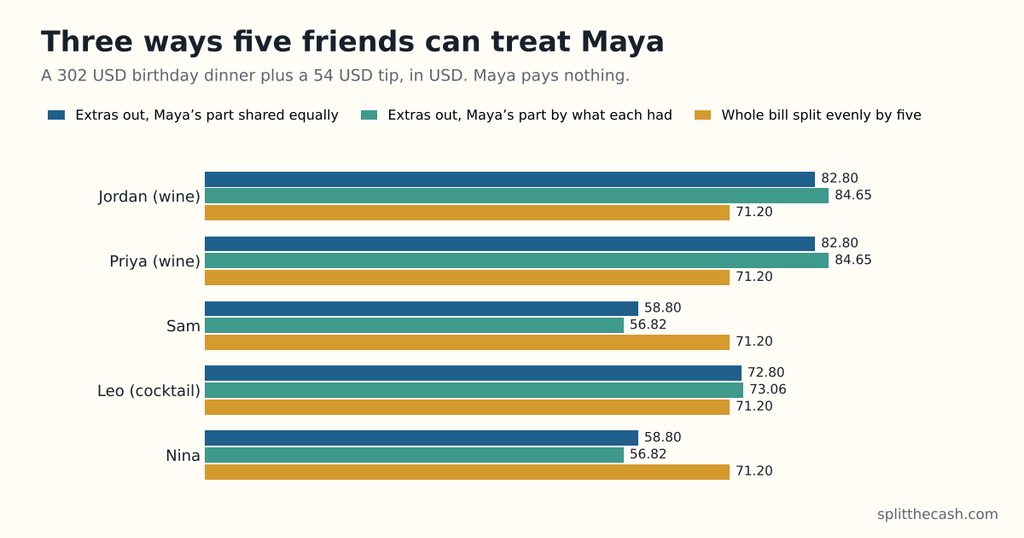
The last column is the simplest: the five split the whole 356.00 USD evenly. Sam and Nina then pay 12.40 USD more than with Maya’s part shared equally, mostly for wine they didn’t drink. When a few people order much more than the rest, taking out the extras first is fairer.
By what each had, 84.65 + 84.65 + 56.82 + 73.06 + 56.82 = 356.00 USD. The calculator rounds to the cent so the amounts always add up to the bill.
Try it with your own numbers
Change the total, the extras and the tip, or tap “Pays nothing” next to someone else. To share Maya’s part by what each had, choose “By what each person had” under “Share the guest of honour’s part”. The full restaurant bill calculator also works item by item, and can add a tax or service charge if the prices don’t include it.
Birthday dinner etiquette: who pays, and how
Most arguments over a birthday bill start because the plan was never said out loud. A few habits prevent them.
- Settle the plan before anyone orders. Etiquette coach Toni Dupree, quoted by Daily Meal, says the decision to split should come before you sit down, not when the bill arrives. A line in the group chat is enough: “We’re all covering Maya, OK?”
- Make one payment, then pay each other back. Daily Meal suggests one person pays by card and the rest reimburse them, or everyone puts in cash. Separate checks make the server’s job harder, so it suggests avoiding them.
- Say early if something is beyond your budget. Gottsman suggests saying, before ordering, that you’re happy to share the meal but not expensive wine. You can also decline an invitation to a place you can’t afford and celebrate the friend another way.
- Someone at the table has a tight budget? Agree on an amount they can pay, and let the others cover the rest. The pay-what-you-can calculator works out what everyone else pays when one person has a limit and another pays nothing.
Common questions
Who pays the bill at a birthday dinner with friends?
With no single host, the friends split the bill and cover the birthday person’s share. Agree beforehand whether that share is split equally or by what each person had; the example above shows both.
Does the birthday girl pay for dinner?
Not if her friends organised it to celebrate her. If she invited everyone herself, she is the host and is usually expected to pay, unless her invitation said everyone would split the bill.
Who typically pays for a birthday party?
The host. The experts in the U.S. News article apply this to children’s parties too: the parent throwing the party pays for the activity, since guests already bring a gift. When two families throw a joint party, the joint party calculator splits the shared costs and each family’s guests.
Should the birthday person’s share include tax and tip?
Yes, if the group is treating them. Their part includes their share of the tip and any tax or service charge, and the others split it. The calculator does this when you tap “Pays nothing” next to their name.
Is it fine to split the whole bill evenly?
It is the simplest choice and works well when everyone ordered about the same. When one or two people had expensive extras, the others end up paying for them; in the example above, Sam and Nina would pay 12.40 USD more each. Taking the extras out first, as in the quick mode of the restaurant bill calculator, avoids that.