
Split a returned security deposit between roommates in two steps: give each person back what they paid in, then take off the deductions. Shared deductions, such as cleaning or the common areas, come off everyone; damage one person caused comes off that person only. Splitting the refund equally, or in proportion to what each paid, makes the others pay for one person’s damage. When one roommate moves out before the others, the landlord usually keeps the deposit until the lease ends, so the person who takes over the room, or the roommates who stay, pay the leaver’s share back.
Do roommates split the security deposit evenly?
Only if they paid it evenly. The landlord holds one deposit for the whole home and usually returns it to the tenants on the lease, or to one of them, so the roommates divide it themselves (RentCafe). Groups pay it in different ways: equally, by room size or rent share, or one person pays and the others pay them back. Whatever you choose, write down at move-in who paid what. That list decides the split at the end.
How to split the deductions
- Shared deductions (cleaning, the kitchen, the living room): split equally, or by room size or rent share if that is how you split the rent (Tellus).
- Damage one person caused (a hole in their wall, a broken blind in their room): that person pays it, even if they have already moved out. Photos of each room at move-in show who is responsible for what.
- Damage in a shared area with a known date: split it between the people who lived there at the time.
- Nobody knows who did it: split it equally between everyone on the lease.
- Normal wear and tear (faded paint, light scuffs, worn carpet along walkways) is not damage. Where the landlord can’t charge for it, don’t charge a roommate for it either.
What a landlord may deduct depends on where you live. In California, a landlord can deduct for damage beyond normal wear and tear and for cleaning back to the condition at move-in, and must send an itemised statement, with receipts for amounts over $125 (California Courts). In England and Wales, a landlord can keep money for rent you owe or the cost of repairs (GOV.UK). Ask for the itemised list: you need it to tell shared deductions from one person’s.
Worked example: a 2,400 USD deposit
Ana, Ben and Chloe paid a 2,400 USD deposit: Ana 1,000 for the largest room, Ben 800 and Chloe 600. When they move out, the landlord keeps 390: 150 for cleaning and 240 to repair a hole in Ben’s wall. They get 2,010 back.
| Who | Paid in | Taken off | Back |
|---|---|---|---|
| Ana | 1,000 | 50 | 950 |
| Ben | 800 | 290 | 510 |
| Chloe | 600 | 50 | 550 |
Amounts in USD. The cleaning is shared equally, 50 each; Ben also pays the 240 for his wall. The amounts add up to 2,010, the refund.
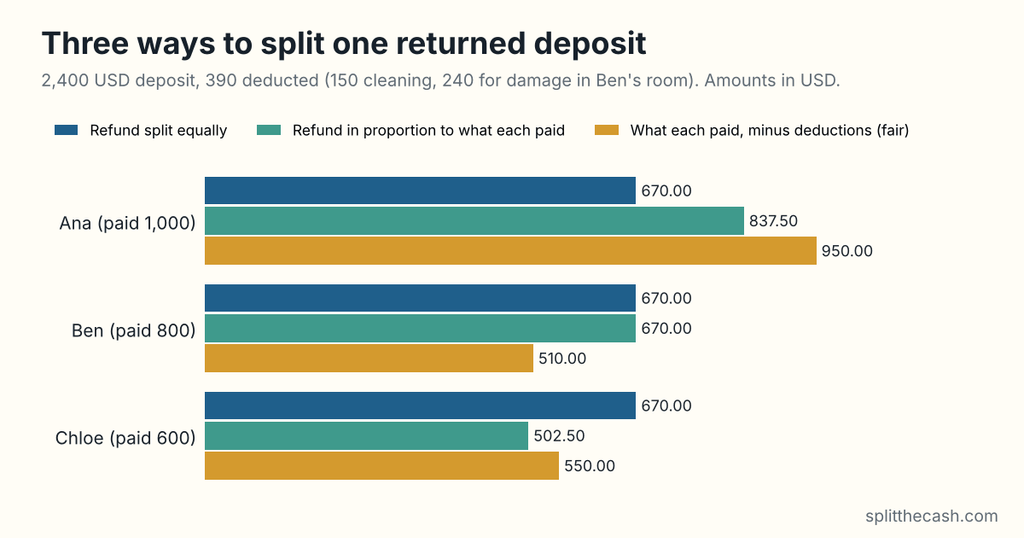
Split equally, everyone would get 670: Chloe would get 120 more than her fair amount and Ana 280 less. Split in proportion to what each paid in, Ana would get 837.50, Ben 670.00 and Chloe 502.50, so Ana and Chloe would pay 160 of Ben’s repair between them.
When one roommate moves out and the others stay
The landlord doesn’t usually return part of the deposit when one roommate leaves. The roommates who stay are typically still responsible for the full lease, and the one who leaves is paid back by the person who replaces them or by those who stay, not by the landlord (RentCafe).
So the roommates settle the leaver’s share between themselves. Before anyone pays:
- Read the lease and tell the landlord. Check who is named on it, the notice period and whether the leaver has to find a replacement. Many landlords need to approve a new roommate and add them to the lease.
- Check who stays liable. If everyone on the lease is responsible for the whole rent and any damage, the leaver can stay responsible after moving out until the lease is changed.
- Walk through the room and shared areas on the leaver’s last day, take dated photos, and agree on any damage they should pay for (Tellus).
Then choose one of three ways to pay the leaver:
1. The new roommate pays the leaver
The person taking the room pays the leaver their share, minus any agreed damage, and takes over that share of the deposit. The roommates who stay pay nothing. Have it paid on or before move-in day, not on a promise.
2. The roommates who stay buy the share
With no replacement yet, the people staying pay the leaver between them: two roommates staying pay half each, and each then owns a bigger part of the deposit. Agree that a future roommate pays them back the same amount when they move in.
3. Wait until the lease ends
Nobody pays now, and the leaver gets their share when the landlord returns the deposit. It costs nothing today, but the leaver may wait months and depends on the others to pay them. Write down who will receive the refund and how soon they will pass on the leaver’s share, for example within two weeks.
Whichever way you choose, agree in writing that once the leaver is paid, they have no further claim on the deposit. Without that, they could ask for a share again when the landlord pays out.
Say Ben leaves on 10 March and Dana moves in on the 11th. Dana pays Ben his 800 share of the deposit (way 1); if Ana and Chloe paid him instead (way 2), they would pay 400 each. March’s rent of 2,400 is split by days: Ana and Chloe 800.00 each, Ben 258.06 for 10 days and Dana 541.94 for 21 days. The calculator below does the rent split; change the names, days and rent to yours.
If nobody moves in, the empty days are shared by everyone in proportion to the days each person lived there. If your lease says the leaver pays until they are replaced, enter their last day as the day before the new person arrives. How to calculate prorated rent explains the methods.
A move-out agreement you can copy
A few lines, confirmed by everyone in a message, prevent most later disputes. Replace the names and numbers with yours:
Ana, Ben and Chloe share the flat. Ben moves out on 10 March. The deposit is 2,400: Ana paid 1,000, Ben 800 and Chloe 600. Dana, who takes Ben’s room, pays Ben 800 on the day she moves in. If she hasn’t paid by then, Ana and Chloe pay Ben 400 each within seven days and Dana repays them when she moves in. Damage in Ben’s room, shown in the photos taken on his last day, comes off his share; damage in shared areas is split equally. Ben pays rent and bills up to his last day before he is paid. Once Ben is paid, he has no further claim on the deposit. Agreed by Ana, Ben, Chloe and Dana on [date].
Keep the agreement and the photos where everyone can find them.
Common questions
Can I keep my roommate’s security deposit?
Not on your own. It is their money, held by the landlord. If they owe you rent or caused damage, agree the amount with them in writing and take it off what you pay them back.
Will I get my deposit back if I move out before my roommate?
Usually not from the landlord, who keeps the deposit until the whole tenancy ends. Agree with your roommates, or the person taking your room, that they pay you your share when you leave.
How long does it take to get a deposit back?
It depends on where you live. In California, the landlord has 21 days after you move out to return the deposit or send an itemised statement (California Courts). In England and Wales, the deposit must be in a protection scheme, and the landlord must return it within 10 days of you both agreeing how much you get back (GOV.UK). Elsewhere, check your local rules.
How much notice should I give my roommate before moving out?
There is no single rule. Check the lease for the landlord’s notice period and your roommate agreement if you have one, and tell your roommates as early as you can, so they have time to find someone for the room.
Do we need a written roommate agreement?
It isn’t required, but it prevents most disputes: who paid what towards the deposit, how the rent and bills are split, and how the refund is divided (RentCafe). For splitting the rent itself, see the rent by room size calculator.
This is general information, not legal advice. Deposit rules differ by state and country.