
To calculate prorated rent, divide the monthly rent by the number of days in that month, then multiply by the days you live there. Moving in on 15 February at 1,400 USD a month, that is 1,400 ÷ 28 × 14 = 700.00 USD. Some leases use a 30-day month or a 365-day year instead, which gives a slightly different amount. The prorated rent calculator works out all three.
How to calculate prorated rent, step by step
- Find the number of days in the month: 28 in February (29 in a leap year), 30 in April, June, September and November, and 31 in the other months.
- Count the days you pay for. Moving in, count from the move-in day to the last day of the month, both included. Moving out, count from the 1st to the move-out day.
- Divide the monthly rent by the days in the month. That is the daily rate.
- Multiply the daily rate by the days you pay for, and round to the cent at the end, not before.
Is prorated rent based on 30 or 31 days?
It depends on the lease. There are three common ways to work out the daily rate, the same three that Redfin’s guide to prorated rent describes:
| Method | Daily rate |
|---|---|
| Days in the month | Monthly rent ÷ days in that month (28 to 31) |
| 30-day month | Monthly rent ÷ 30, every month |
| Days in the year | Monthly rent × 12 ÷ 365 (366 in a leap year) |
With the days-in-the-month method, a day costs more in a short month and less in a long one. The other two charge the same daily rate all year, so a 30-day month costs a little more than the real days in a 31-day month and less in February.
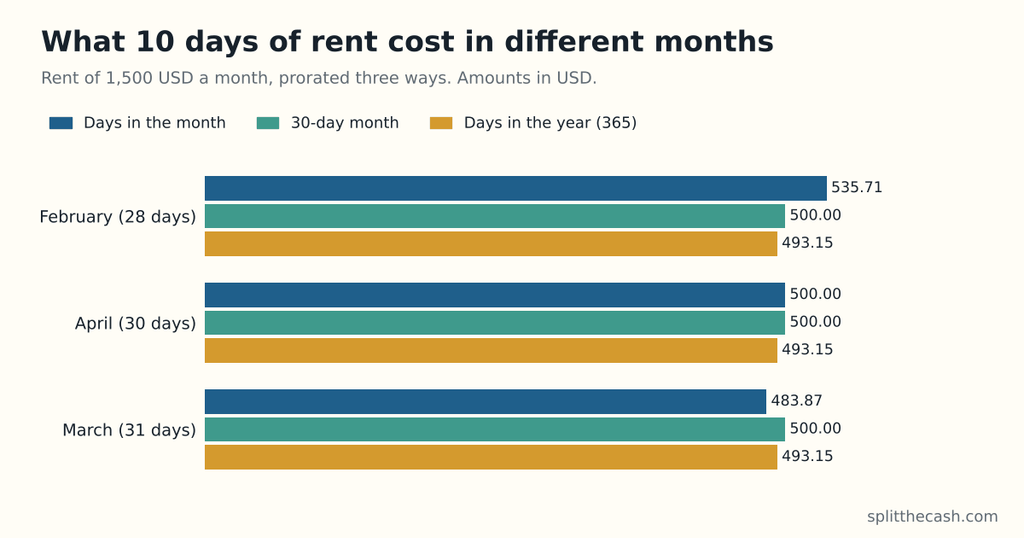
Ten days in February cost 535.71 USD by the days in the month, 35.71 more than with a 30-day month. The same ten days in March cost 483.87. If your lease doesn’t say which method it uses, agree on one before you pay.
Worked example: moving in on 15 February
The rent is 1,400 USD a month, and Sam moves in on 15 February 2027. February 2027 has 28 days, and Sam pays for 15 to 28 February: 14 days, exactly half the month.
| Method | Sum | Sam pays (USD) |
|---|---|---|
| Days in the month | 1,400 ÷ 28 × 14 | 700.00 |
| 30-day month | 1,400 ÷ 30 × 14 | 653.33 |
| Days in the year | 1,400 × 12 ÷ 365 × 14 | 644.38 |
Half of February costs half the rent by the days in the month. The other two methods charge less in February, because they spread the rent as if the month were longer. From March on, Sam pays the full 1,400 USD on the usual day.
Worked example: moving out on 20 June
Sam moves out on 20 June 2027. Counting the move-out day, Sam pays for 1 to 20 June: 20 of the month’s 30 days.
| Method | Sum | Sam pays (USD) |
|---|---|---|
| Days in the month | 1,400 ÷ 30 × 20 | 933.33 |
| 30-day month | 1,400 ÷ 30 × 20 | 933.33 |
| Days in the year | 1,400 × 12 ÷ 365 × 20 | 920.55 |
June has 30 days, so the first two methods give the same amount. If the lease doesn’t charge for the move-out day, Sam pays for 19 days: 886.67, 886.67 or 874.52 USD.
Roommates who moved on different days
In a shared home, one person may move out on the 10th and another move in on the 15th. Split the month’s rent by the days each person lived there, and the shares still add up to the full rent. The prorated rent calculator does this when you choose Roommates. The days the room stood empty are then shared by everyone, in proportion to the days each person lived there, including the person who left.
How you split the rent between yourselves doesn’t change the lease. A roommate who moves out but is still named on it may still owe the landlord rent until the lease ends or someone takes their place, so check the lease before you agree a split.
Common prorated rent mistakes
- Mixing methods. If one person uses the days in the month and another a 30-day month, the totals won’t match. Pick one and use it for every move.
- Counting the days differently. Whether the move-in and move-out days count changes the amount by a full day’s rent. Say “from the first day to the last day, both included”, or whatever you agree.
- Rounding the daily rate first. 1,500 ÷ 31 rounded to 48.39, times 10, gives 483.90; the exact amount is 483.87. Multiply first, then round once.
- Charging more than the rent. With a 30-day month, the 31 days of a long month would cost more than the rent. A whole month is always the full rent.
- Leaving the dates vague. “End of the month, roughly” is not a date. Agree in writing the method, the exact first and last days, who covers an empty room and when the money is paid.
Try it with your own numbers
Change the rent and the date, or choose Moving out. The calculator shows what you pay using the real days in the month, with the 30-day and 365-day amounts below it.
Common questions
When do you pay prorated rent?
The lease decides. Moving in, it is usually collected when you sign the lease; moving out, before the last day of the lease (Baselane). Agree the amount and the date in writing before you move.
What is prorated rent for the first month?
It is the rent for the days from your move-in day to the end of that month, instead of the full month’s rent. From the next month on, you pay the full rent on the usual due date.
Is prorated rent required?
Usually not. In most places it is up to the lease, and the law usually doesn’t require it, so a landlord can charge for the full month (Redfin). There are exceptions. In California, when a month-to-month tenancy ends after notice, Civil Code section 1946 says the rent is due “to and including the date of termination” (California Civil Code § 1946). For Texas, Tenant Rights USA says the law doesn’t require landlords to prorate unless the lease or a written agreement says so (Tenant Rights USA). For Ontario we found no official rule: the province’s guide to the standard lease doesn’t cover partial months. Wherever you rent, check the lease, and ask your local tenant board if it isn’t clear. This is general information, not legal advice.
How do I calculate prorated rent in Excel?
Put the date in A2 and the monthly rent in B2. For a move-in date, use:
=ROUND(B2/DAY(EOMONTH(A2,0))*(EOMONTH(A2,0)-A2+1),2)For a move-out date, counting that day:
=ROUND(B2/DAY(EOMONTH(A2,0))*DAY(A2),2)DAY(EOMONTH(A2,0)) is the number of days in that month. Replace it with 30 if your lease uses a 30-day month.
Is prorated rent the same as pro rata pay?
It is the same idea: pro rata means in proportion. Pro rata pay is a full amount scaled by the part worked. A full-time salary of 30,000 for 40 hours a week becomes 18,000 for 24 hours (30,000 × 24 ÷ 40). Whether pay is prorated by hours, days or months depends on the contract. To share a bonus between people in proportion to their salaries, see the bonus split calculator.
Is a security deposit prorated?
No. A security deposit is not prorated (Redfin): you pay the full deposit even if the first month is short.