
When bedrooms are different sizes, the fairest common way to split rent is in two parts: share the cost of the common areas (kitchen, living room, shared bathroom) equally, and split the rest by the size of each bedroom. Splitting only by bedroom size charges the person with the big room for space everyone uses; splitting equally charges the person in the small room for space they don’t have. The rent split calculator by room size does both parts to the cent.
Ways to split rent between roommates
| Method | When it fits |
|---|---|
| Equally | Rooms are about the same, or the differences balance out |
| By room size only | Bedrooms differ and the shared space is small |
| Common areas equal, the rest by room size | Bedrooms differ and everyone uses the shared rooms |
| By income | Couples or family who agree to it |
RentCafe’s guide describes the same main options: equal, by private square footage, by features such as an en suite bathroom, and by income (RentCafe).
How to split rent by room size, step by step
- Measure each bedroom wall to wall, length × width, including any built-in closet. Leave out shared bathrooms and hallways. Use the same unit, square feet or square metres, for every room.
- Agree how much of the rent pays for the common areas. One simple way: the common areas’ share of the flat’s floor area. If they are 40% of the floor, use 40%.
- Divide the common part equally between everyone living there.
- Split the rest by bedroom size: rent for the rooms × your room’s size ÷ the size of all the bedrooms.
- Add the two parts. Check the amounts add up to the rent.
your rent = rent × common % ÷ people
          + rent × (100% − common %) × your room ÷ all bedrooms
Worked example: three rooms, 2,400 USD
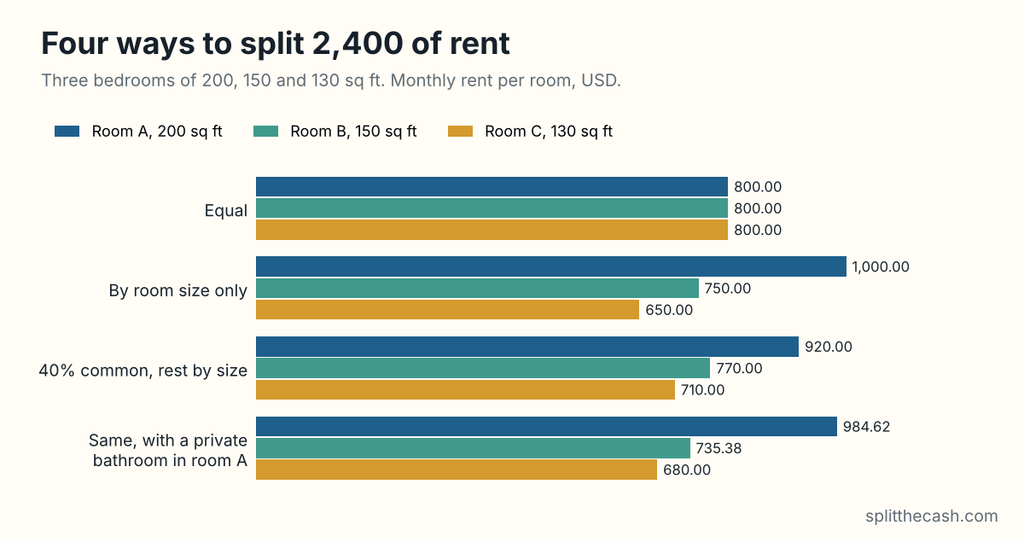
Three roommates rent a flat for 2,400 USD a month. The bedrooms are 200, 150 and 130 square feet, 480 in total. They agree that 40% of the rent, 960 USD, pays for the common areas.
| Room | Equal | By size | 40% common |
|---|---|---|---|
| A, 200 sq ft | 800 | 1,000 | 920 |
| B, 150 sq ft | 800 | 750 | 770 |
| C, 130 sq ft | 800 | 650 | 710 |
With 40% common, each person pays 320 for the common areas, and the other 1,440 is split by size: 600, 450 and 390. Room A pays 120 more than an equal split, not 200 more as it would split by size only.
Try it with your own rooms. The calculator works with square feet or square metres: only the ratio between rooms matters, so ignore the m² label if you measured in feet.
When rooms differ in more than size
Floor area isn’t everything a room offers. Features worth pricing:
- a private or attached bathroom;
- a walk-in closet or built-in wardrobe;
- light and view: a big window, or one facing a wall;
- noise: on the street, next to the lift or the kitchen;
- privacy: a room others walk through, or one that opens onto the living room.
There are two ways to price them, after the room size split. Adjust only for things other than size, so size isn’t counted twice.
- Count it as extra space. If room A has its own bathroom, add its area, or an agreed amount such as 40 square feet, to room A’s size. In the example, room A becomes 240 and pays 984.62; rooms B and C pay 735.38 and 680.
- Move round amounts between rooms. Agree adjustments in round numbers that add up to zero, so the total stays the rent. Starting from 920 / 770 / 710: room A pays 100 more for its bathroom and room C, on the street, 100 less. The split becomes 1,020 / 770 / 610.
A couple in one room
A couple uses the shared rooms twice as much as one person but has one bedroom. Count them as two people for the common part and as one room for the size part. In the calculator, enter each partner separately with half the room’s size. If a couple shares room B in the example, the common 960 is split between four people (240 each) and the room part stays the same: room A pays 840, the couple 930 together (465 each), room C 630.
Letting roommates price the rooms
A good test of any split: would each person accept any of the rooms at that room’s price? If someone would happily swap, their room is underpriced. When rooms are hard to compare, such as an attic with a sloped ceiling against a room with its own entrance, let the people who will live there set the prices:
- Each person privately writes a price for every room, with the prices adding up to the rent.
- Everyone shows their prices at the same time, so nobody follows the loudest voice.
- Average each room’s prices. The averages add up to the rent too.
- Each person picks a room at its average price. If two want the same room, the one who priced it higher takes it; if that ties, draw lots.
Averaging is a rough version. Fair-division tools do this properly, setting prices at which nobody would rather have someone else’s room: Spliddit’s rent tool works this way, and the New York Times published a rent calculator based on a method by the mathematician Francis Su (Goldman and Procaccia, 2014).
When roommates still disagree
- Find the one number someone objects to and talk only about that.
- Ask them to propose a replacement that still adds up to the rent. Lowering one room raises another, which makes the trade-off plain.
- Use the swap test above: at what price would you take a different room?
- Agree the split for two or three months, then look at it again once everyone knows the rooms.
- At lease renewal, rooms can be reassigned and the split worked out again.
Common questions
How do I calculate a rent split?
Equally, divide the rent by the number of people. By room size, multiply the rent by your room’s size and divide by the size of all the bedrooms. With common areas, add an equal share of the common part to your room part, as in the formula above.
How do I split 700 between 3 people?
700 ÷ 3 is 233.333…, so two people pay 233.33 and one pays 233.34, so that the total is exactly 700. The equal split calculator handles the extra cents for any amount.
Can we split rent by income?
Yes, if everyone agrees: each pays the rent × their income ÷ everyone’s income. In the rent calculator, change “Split according to” to Salary and enter each person’s monthly income.
What about utilities?
Bills such as internet and electricity are usually split equally, since everyone uses them, while the rent follows room size. Use the equal split for the bills.
Someone moves in or out mid-month. How is the rent split?
By the days each person lived there that month: the prorated rent calculator does it. For the deposit when a roommate leaves, see how to split the security deposit.
Whatever you choose, write it down in a message to everyone or a shared note: the total rent, each person’s share, the method, when each share is due, how bills are split, and when you will look at it again. Look again when someone moves in or out, the rent goes up, a room changes, or someone starts working from home. The landlord usually deals with the total rent, so check your lease for who is responsible for the full amount; the split between roommates is a separate agreement between you.