
Couples should split bills 50/50 when they earn about the same. When one partner earns noticeably more, many couples split bills based on income instead: each pays the same percentage of what they earn, so the bills take the same bite out of both pay checks. Neither is right for everyone. What matters is that both of you agree, you both know the numbers, and you look at it again when your incomes change.
To see what each of you would pay, enter your shared costs and your incomes in the rent and bills by income calculator.
How do most couples split bills?
In Britain, YouGov asked people in 2024 how couples should share household bills. 48% said bills should be split according to how much each partner earns, and 37% said 50-50. In practice, among working couples who live together, 46% split 50-50 and 38% in proportion to their income. Where both earn about the same, or one earns only a little more, 69% split 50-50. Where one partner earns notably more, 49% split by income, but a third still split 50-50 (YouGov, 29 August 2024).
How couples hold their money also varies. In a YouGov survey for Bankrate in December 2025, 38% of US couples who are married or live together had completely combined their finances, 36% had a mix of joint and separate accounts, and 26% kept them completely separate. Younger couples were the most likely to keep separate accounts: 51% of Gen Z couples did (Bankrate, 9 February 2026). Couples with separate money are the ones who have to decide how to split the bills.
Four ways to split bills as a couple, on one example
Mia takes home 4,200 USD a month and Dan 2,800, so Mia earns 60% of what they bring in together. Their shared costs are 2,400 USD a month: rent 1,600, utilities 180, internet 60 and groceries 560.
| Method | Mia pays | Dan pays | Share of pay (Mia / Dan) | Left over (Mia / Dan) |
|---|---|---|---|---|
| 50/50 | 1,200 | 1,200 | 28.6% / 42.9% | 3,000 / 1,600 |
| By income (60/40) | 1,440 | 960 | 34.3% / 34.3% | 2,760 / 1,840 |
| Half equal, half by income | 1,320 | 1,080 | 31.4% / 38.6% | 2,880 / 1,720 |
| Equal money left over | 1,900 | 500 | 45.2% / 17.9% | 2,300 / 2,300 |
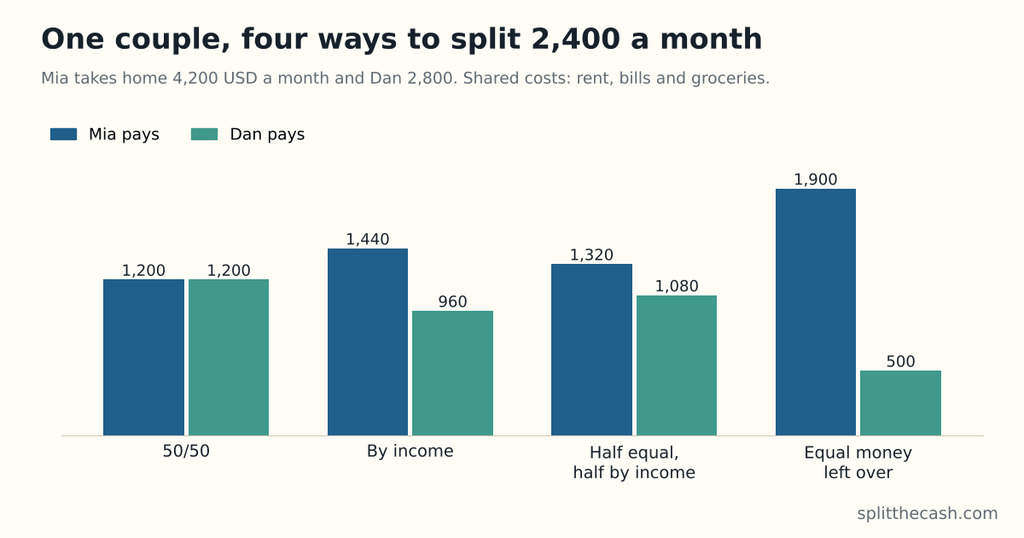
- 50/50. Simple, and it feels fair when incomes are close. With Mia and Dan, the bills take 43% of Dan’s pay and 29% of Mia’s, and Dan has 1,600 left against Mia’s 3,000.
- By income. Each pays the same percentage of their pay, here 34.3%. The higher earner pays more in money, the same in proportion.
- Half equal, half by income. A middle way for couples who find 50/50 too hard on one of them and a full income split too much for the other. In the calculator, choose “Mix: equal + income”.
- Equal money left over. Both end up with the same amount after the bills, as if you pooled everything. It suits couples who share most of their money anyway. When incomes are far apart, the lower earner pays very little or nothing.
How to split bills based on income
Splitting bills based on income is also called a proportional split: each of you pays in proportion to what you earn, so a 60/40 income gap means a 60/40 split of the bills.
- Agree which income you use: take-home pay or gross pay, the same kind for both.
- Add your two monthly incomes together. Mia 4,200 + Dan 2,800 = 7,000.
- Divide each income by the total. Mia 4,200 ÷ 7,000 = 60%, Dan 40%.
- Add up the shared costs for the month and multiply by each percentage. 2,400 × 60% = 1,440 for Mia, 2,400 × 40% = 960 for Dan.
your share = shared costs × your income ÷ both incomesThe calculator below has Mia and Dan’s numbers. Change them to yours; it rounds to the cent and the two amounts always add up to the total.
Which costs should couples share?
Decide this before you decide how to split. Most couples share the costs of the home they live in and keep personal spending separate.
| Cost | Usually |
|---|---|
| Rent or mortgage, home insurance | Shared |
| Utilities, internet, council or property tax | Shared |
| Groceries and household supplies | Shared |
| Childcare and costs for the children | Shared |
| Holidays and meals out together | Shared, or taken in turns |
| Car | Shared if you both use it |
| Phone, clothes, hobbies, gifts for each other | Personal |
| Debts from before you met | Usually personal |
Saving for something together, such as a deposit or a wedding, can be split the same way as the bills, or by a fixed amount each.
How to pay: a joint account, transfers or bills each
- A joint account for the bills. Each of you pays your share into it every payday, and the bills come out of it. Everything else stays in your own accounts. This is the “set amount into a joint account” set-up that 27% of British couples living together use (YouGov, 2024).
- One pays, the other transfers. The bills come out of one account and the other partner sends their share once a month. Simple, but the account holder carries the risk if a payment is late.
- Bills each. One pays the rent, the other the utilities and groceries. Easy at first, but the split drifts as prices change; check the totals every few months. To even them out, add up who paid what with the settle-up calculator.
How to talk about it when one of you earns more
- Share the real numbers. Take-home pay, fixed costs and any debts. A split only feels fair when both of you can see the sums.
- Agree the list of shared costs first. Many arguments about 50/50 are really about what counts as shared.
- Keep personal money for each of you. Whatever the split, both should have some money they spend without asking.
- Count unpaid work too. If one of you does more of the childcare or housework, or works fewer hours for the family, a plain income split may not be the fairest.
- Review it once a year, and whenever one of you changes job, goes part-time, or has a child.
Common questions
Should couples split bills 50/50?
If you earn about the same, 50/50 is the simplest and most couples in that position use it. If one earns a lot more, 50/50 leaves the lower earner with much less money each month, and many couples switch to splitting by income. The table above shows the difference on one couple.
Is it normal for couples to split bills?
Yes. Most couples who keep some money separate split the shared bills in some way, equally or by income. Couples who put all their income into one account don’t need to split at all.
Is it fair to split bills based on income?
It is fair in one clear sense: the bills take the same share of each person’s pay. Whether it is fair for you depends on what else you share, how you divide unpaid work, and whether you both agree. In the YouGov survey, more people chose it as the fairest way than chose 50-50.
Should married couples split bills 50/50?
Many married couples combine their money, so there is nothing to split. Those who keep separate accounts use the same methods as other couples. Splitting by income or keeping equal money left over is more common when one partner earns much more or stays home with children.
What if my partner wants to split everything 50/50?
Show the numbers rather than argue the principle: what each of you has left after the bills under 50/50 and under an income split. Suggest a middle way, such as half equal and half by income, or 50/50 on the bills with the higher earner paying more often for meals out and holidays.
What is the best way to split rent with a partner?
The same four ways work for rent on its own. Rent is usually the biggest shared cost, so it is where the gap between 50/50 and an income split shows most: with Mia and Dan’s 1,600 rent, 50/50 is 800 each and by income 960 and 640. The rent and bills by income calculator works it out for your rent and incomes.
How do we split bills when one partner owns the home?
Often the partner who doesn’t own pays toward the running costs, utilities and groceries, plus an agreed amount for living there, rather than part of the mortgage, since the mortgage builds the owner’s share of the home. Write down what the payments are for. Whether paying toward a home gives a partner any claim to it depends on the country and on whether you are married, so get legal advice if it matters to you.
What if one of us has no income?
An income split then puts all the bills on the partner who earns. Couples in that position, for example while one is studying or at home with a baby, often switch to equal money left over or simply pool their income for that time, and agree when they will look at it again.
Should we use gross or take-home pay?
Either works if you use the same kind for both. Take-home pay is closer to what each of you can spend, especially when one pays more tax or puts more into a pension.
What is the easiest way to split bills between couples?
Work out each person’s monthly share once, each pay it into a joint account on payday, and pay all the shared bills from that account. You only need to redo the sums when a bill or an income changes. For bills split with roommates rather than a partner, see how to split bills with roommates.
This is general information, not financial or legal advice.