
To split travel costs with friends, agree before you book how each kind of cost is shared, let whoever pays log it with who it was for, and settle once at the end. Each person’s balance is what they paid minus their fair share; the people who owe then pay the people who are owed, in a few transfers. The settle-up calculator does the sums and lists the transfers.
How to split travel expenses with friends, step by step
- Before anyone books, agree how the big costs (the place to stay, car hire, flights booked together) are shared, and how the daily ones (food, fuel, tickets) are.
- Agree the rules for the awkward cases: someone who skips an activity, someone who upgrades, someone who arrives late.
- During the trip, whoever pays notes the amount, what it was and who it was for. A shared note in the group chat is enough.
- Keep everything in one currency (see the questions below).
- At the end, enter the list in the settle-up calculator and send everyone the link with the transfers.
Ways to split travel costs
Most trips need more than one method: one for the place to stay and another for daily spending.
| Method | When it fits | Calculator |
|---|---|---|
| Equally between everyone | Everyone was there and used it: the house for the whole week, the car, shared groceries | Split equally |
| Only between the people who took part | An activity or a dinner some skipped | Settle up (tick who it was for) |
| By nights stayed | Someone arrived late or left early | Costs by nights stayed |
| By what each person ordered | A restaurant bill where some had much more | Restaurant bill |
| With a limit for some | One friend has a fixed budget, or someone pays nothing | Pay what you can |
Two other habits are common. A kitty, where everyone puts the same amount into a pot and small shared costs are paid from it, saves logging every coffee and toll. Taking turns to pay for dinners works for close friends when the meals cost about the same. Both still need a check at the end: share out what is left in the kitty, and note any meal that cost much more than the others.
How to calculate who owes who
- For each expense, divide the cost between the people it was for. That gives each person’s share of it.
- Add up, for each person, what they paid and what their shares come to.
- Their balance is what they paid minus their shares. A positive balance is money to get back; a negative one is money owed. The balances always add up to zero.
- Match the people who owe with the people who are owed. The calculator pairs the largest debt with the largest amount owed, again and again, so a group of four needs at most three transfers.
Paying each expense back separately takes far more transfers. In the example below, it would mean 22 separate paybacks instead of 3.
Worked example: a week in a rented house
Ana, Ben, Chloe and Dan rent a house for seven nights at 140 EUR a night. Dan arrives two days late, so the first two nights are shared by three. Ana skips the boat trip. This is what they paid, 1,963.00 EUR in all:
| Expense | Paid by | EUR | For |
|---|---|---|---|
| House, nights 1–2 | Ana | 280.00 | Ana, Ben, Chloe |
| House, nights 3–7 | Ana | 700.00 | Everyone |
| Car hire | Ben | 210.00 | Everyone |
| Groceries | Chloe | 186.40 | Everyone |
| Fuel | Dan | 64.00 | Everyone |
| Boat trip | Ben | 150.00 | Ben, Chloe, Dan |
| Dinner out | Dan | 132.60 | Everyone |
| Ferry home | Ben | 240.00 | Everyone |
The first two nights, 280.00 EUR between three, don’t divide exactly. The calculator gives one person the extra cent, 93.34 for Ana and 93.33 each for Ben and Chloe, so the shares still add up to 280.00.
| Person | Paid (EUR) | Fair share | Balance |
|---|---|---|---|
| Ana | 980.00 | 476.59 | +503.41 |
| Ben | 600.00 | 526.58 | +73.42 |
| Chloe | 186.40 | 526.58 | −340.18 |
| Dan | 196.60 | 433.25 | −236.65 |
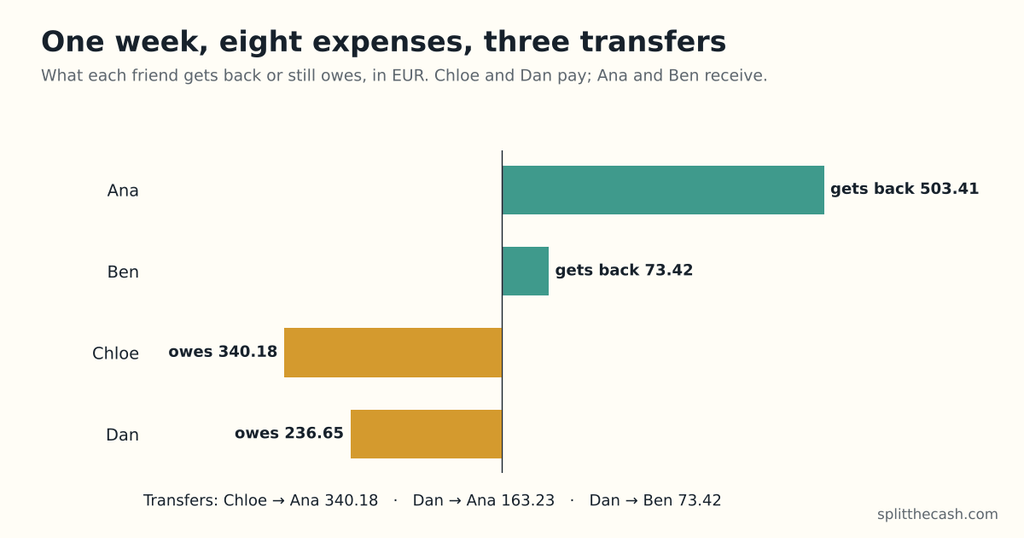
The fair shares add up to 1,963.00 EUR, and the balances to zero. Three transfers settle the whole week: Chloe pays Ana 340.18, Dan pays Ana 163.23, and Dan pays Ben 73.42.
Splitting everything equally would be simpler: 490.75 EUR each. But Dan would pay 57.50 EUR more for two nights he wasn’t there, and Ana 14.16 more for a boat trip she skipped. Logging who each expense was for is what keeps the split fair.
Try it with your own numbers
Change the names and add your own expenses. Leave all names untapped for something everyone shared. The share link carries the whole list, so everyone can check it; nothing is stored on the site.
Common questions
How do you split expenses between 3 people?
Add up what everyone paid and divide by three for each person’s share. If Ana paid 90 for the hotel, Ben 30 for dinner and Chloe nothing, the total is 120 and each share is 40. Ana is owed 50, Ben owes 10 and Chloe owes 40, so Chloe pays Ana 40 and Ben pays Ana 10. When an amount doesn’t divide by three, someone pays a cent more, so the total still matches.
What app can I use to split trip expenses with friends?
Apps such as Splitwise and Tricount keep a running list during the trip and suggest the repayments, which suits long trips or groups that share costs all year. Each person usually needs the app. Tricount says it is free, with no ads or daily expense cap (Tricount); Splitwise’s free plan limits how many expenses can be added each day. For a one-off trip, a web calculator like the settle-up calculator needs no app or account: enter the list once at the end and share the link.
Can I split travel expenses in Excel?
Yes. Use one row per expense, with columns for the amount, who paid and one column per person for their share. Each person’s balance is what they paid minus the sum of their share column. Watch the rounding: 280.00 ÷ 3 shown as 93.33 three times adds up to 279.99, so one share needs the extra cent. You still have to work out the transfers by hand.
How do we split costs paid in different currencies?
Choose one currency for the whole trip and convert each expense when it is paid, using the amount on the payer’s card statement or one agreed rate for the trip. Then enter everything in that currency. Converting at different rates later is where small disagreements start.
What if someone skips an activity or wants an upgrade?
Someone who says no before it is booked doesn’t pay for it; someone who drops out after it is paid usually still pays their share. With an upgrade, everyone shares the basic price and the person who upgrades pays the difference. Agree both rules before the trip.
What if one friend has a smaller budget?
Agree before booking what they can pay for the shared costs. The pay-what-you-can calculator sets their limit and shares the rest equally between the others.