
To split tips by hours worked, add up everyone’s hours, divide the tip pool by that total to get the tips per hour, then multiply each person’s hours by that rate. Someone who worked 30 hours gets three times as much as someone who worked 10. The tip pool calculator by hours worked does it to the cent, so the amounts always add up to the pool.
The formula: tips per hour
tips per hour = tip pool ÷ total hours
your tips     = tips per hour × your hours
Step by step
- Choose the period: a shift, a day or a week. Count only the tips taken in that period.
- Write down the hours each person worked in that period, from the rota or the clock-in records. Use decimals: 7 hours 30 minutes is 7.5.
- Add up the hours.
- Divide the pool by the total hours to get the tips per hour.
- Multiply by each person’s hours. Round to the cent and check the amounts add up to the pool. If they are a cent or two out, give the extra cents to the people whose amounts were rounded down the most. The calculator does this for you.
Worked example: 1,150 USD between four people
A week’s tip pool is 1,150 USD. Four people worked 100 hours between them, so the tips are 11.50 USD an hour.
| Person | Hours | Tips |
|---|---|---|
| Ana, server | 34.5 | 396.75 |
| Ben, server | 28 | 322.00 |
| Cleo, busser | 22 | 253.00 |
| Dev, bartender | 15.5 | 178.25 |
| Total | 100 | 1,150.00 |
Try it with your own team. Change the names, hours and amount, then send everyone their share with the buttons under the result.
In Excel or Google Sheets
Put the names in column A (A2 to A5), the hours in column B and the tip pool in cell E1. In C2, enter the formula below and copy it down to C5. It works the same in Excel and Google Sheets.
=ROUND($E$1*B2/SUM($B$2:$B$5), 2)Then check the total with =SUM(C2:C5). Rounding each share can leave the total a cent or two off the pool; if it does, add or take off those cents by hand. For more people, extend the ranges, for example to B20.
Hours and roles together: role points
Some teams give each role a number of points, so an hour in one role counts for more than an hour in another. Each person’s share then follows hours × role points instead of hours alone. Which roles get which points is for your team or workplace to agree; the numbers below are only an example.
Say servers and the bartender count 1 point an hour and the busser 0.5. Cleo’s 22 hours become 11 points, and the total is 89 points instead of 100 hours.
| Person | Hours × points | Tips |
|---|---|---|
| Ana | 34.5 × 1 = 34.5 | 445.79 |
| Ben | 28 × 1 = 28 | 361.80 |
| Cleo | 22 × 0.5 = 11 | 142.13 |
| Dev | 15.5 × 1 = 15.5 | 200.28 |
| Total | 89 | 1,150.00 |
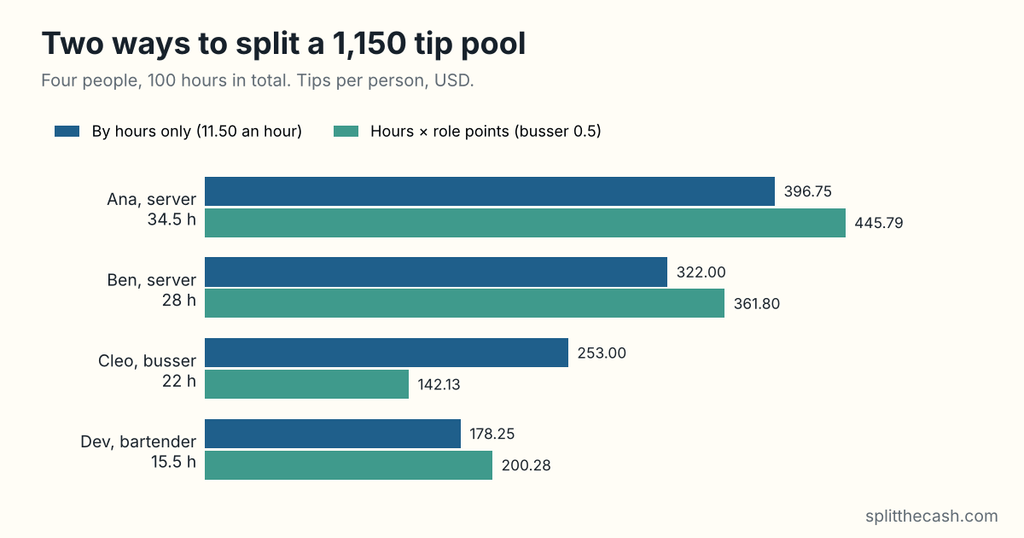
To do this in the calculator, change “Split according to” to Points and enter each person’s hours × points, worked out as in the table.
Tip pool or tip-out?
In a tip pool, everyone’s tips go into one pot that is then shared, for example by hours. In a tip-out, each server keeps their own tips and passes a set part on to other staff, such as bussers or the bar. The workplace sets what that part is: for example, if the bar’s tip-out is 2% of a server’s sales and the server sold 1,800, the bar gets 1,800 × 2% = 36. This guide and the calculator cover the first: one pot, shared out.
Who can share in a tip pool: the rules
This is general information, not legal advice. Rules differ by country, and in the US also by state, so check the ones that apply to your workplace.
United States. Under federal law, an employer may not keep any part of employees’ tips, and managers and supervisors may not receive tips from the pool. If the employer pays tipped staff less than the full minimum wage and counts tips towards the rest (a “tip credit”), the pool can include only staff who usually receive tips, such as servers and bartenders. If everyone is paid at least the full minimum wage, the pool can also include staff such as cooks and dishwashers (US Department of Labor, Fact Sheet 15). The fact sheet covers who may share in the pool, not a formula for dividing it.
United Kingdom. Since 1 October 2024, employers must pass on all tips to workers, allocate them fairly, and pay them out by the end of the month after they were received. Where tips are paid more than occasionally, the employer needs a written tipping policy and must keep a record of tips for three years. The code of practice lists hours worked during the period, type of role, team or individual performance, and seniority as examples of factors an employer might use (GOV.UK, code of practice on fair and transparent distribution of tips). A further change requiring employers to consult workers on the policy is planned under the Employment Rights Act 2025; a revised code was withdrawn in July 2026 for a new consultation, and no start date had been confirmed at the time of writing.
Common questions
How do you calculate tips based on hours worked?
Divide the pool by the total hours everyone worked, then multiply by each person’s hours. A 600 pool and 48 hours in total is 12.50 an hour, so someone who worked 8 hours gets 100.
Can my manager be in the tip pool?
In the US, no. Under federal law a manager or supervisor may not receive any tips from the pool, even on a shift they work as a server or bartender. They may keep a tip a customer gives them directly for service only they provided (US Department of Labor, Fact Sheet 15B). The Department repeated this for a shift supervisor who also bartends in an opinion letter of 7 September 2026 (FLSA2026-13).
Hours or shifts?
Hours are fairer when shifts differ in length. Counting shifts treats a 4-hour lunch shift the same as a 9-hour double. If all shifts are the same length, the result is the same either way.
Do breaks count as hours worked?
That is for the tipping policy to say. Whatever you choose, apply it to everyone in the same way, for example by using the paid hours from the payroll records.
How do you divide cash tips by hours worked?
The same way: count the cash, divide it by the total hours and multiply by each person’s hours. Cash and card tips can go into one pool for the period. If card tips are paid through payroll and cash tips on the day, you can run the split twice, once for each, with the same hours.
Can I split tips equally instead?
Yes, if everyone worked about the same hours. Use the equal split calculator, which handles the extra cents. For money earned together outside a restaurant, such as a job several people did, see the shared job payment split.