
Business partners split profit however their partnership agreement says. Without an agreement, the law in the UK and in many US states splits it equally, whoever put in more money or does more of the work. When the partners put in different amounts, they can split the profit in proportion to their capital; when one does more of the work, the fairest way is usually to pay that work first, as an agreed salary, and then split the rest. The profit split calculator works out each share to the cent.
Do partners have to split profits equally?
Only if they haven’t agreed anything else. In the UK, the Partnership Act 1890 says that, subject to any agreement between the partners, “All the partners are entitled to share equally in the capital and profits of the business”, and that no partner is entitled to pay for working in the business (Partnership Act 1890, section 24). The Uniform Partnership Act, which many US states use, has the same default: “Each partner is entitled to an equal share of the partnership profits” (Iowa’s version, section 486A.401).
So if one partner put in more money, or works full time while the other doesn’t, write down the split you want before the first profit comes in. A partnership agreement normally says how profit is shared (OpenLearn).
Four ways to split profit between partners
| Method | When it fits |
|---|---|
| Equally | Partners put in about the same money and work |
| By capital | The money each put in is what matters most |
| Agreed percentages (70/30) | Partners agree a split that reflects money, work and skills together |
| Salary for work, then the rest | One partner works much more than the other |
The formula is the same for any share: each partner’s profit = total profit × their share. By capital, a partner’s share is the money they put in ÷ the money all partners put in.
Worked example: one partner puts in more money, the other more work
Ana and Ben run a small business. Ana put in 40,000 EUR and works on it one day a week. Ben put in 10,000 EUR and works full time. This year’s profit is 60,000 EUR.
| Method | Ana | Ben |
|---|---|---|
| Equally | 30,000 | 30,000 |
| By capital (80/20) | 48,000 | 12,000 |
| Half equally, half by capital | 39,000 | 21,000 |
| 30,000 salary for Ben, rest by capital | 24,000 | 36,000 |
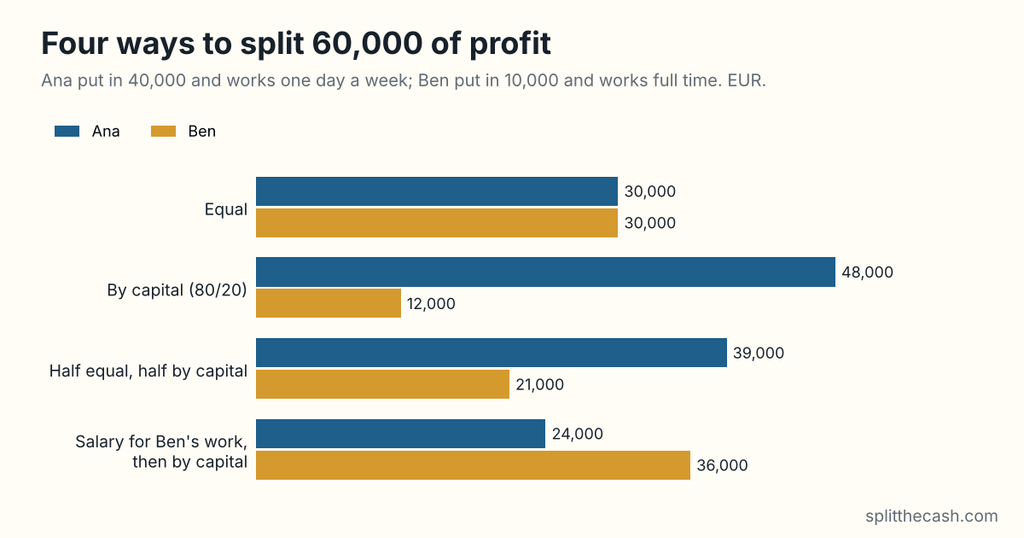
Split equally, Ana’s extra 30,000 of capital earns her nothing. Split by capital, Ben’s full-time work earns him nothing. The last method pays both: Ben first gets an agreed 30,000 for his work, and the remaining 30,000 is split by capital, 24,000 to Ana and 6,000 to Ben, so Ben takes 36,000 in total. The amount for the work is whatever the partners agree; one way to set it is what it would cost to hire someone to do that job.
Try it with your own numbers. The calculator below splits what is left after Ben’s salary by the money each put in. Add the salary to the working partner’s share afterwards.
To split half equally and half by capital, choose “Mix: equal + amount invested” in the profit split calculator and set the equal part to 50%.
Agree it in writing
- How profit is split: equally, by capital, by agreed percentages, or a salary first.
- The amount and terms of any salary for work, and what happens if the profit is smaller than the salary.
- How losses are shared.
- When profit is paid out, and how much stays in the business.
- When the split is reviewed, for example once a year or when someone’s hours change.
Common questions
How does a 70/30 partnership work?
One partner gets 70% of the profit and the other 30%, as agreed between them. On 60,000 of profit, that is 42,000 and 18,000. The percentages often reflect a mix of money, work and skills that is hard to measure separately. Use “By percentage” in the profit split calculator.
How do you split profit between 2 partners, or 3?
The same way, with one share per partner. Split equally, 50,000 between three partners is 16,666.67, 16,666.67 and 16,666.66: one partner gets a cent less, so the parts add up to the total. The calculator handles the cents for you.
Is profit split before or after partners’ pay?
If you agree a salary for work, take it out first and split what is left, as in the example. In the UK, a partner has no right to pay for working in the business unless the partners agree it.
What is sweat equity?
Sweat equity usually means a share of ownership earned with work instead of money. It is a question about who owns the business, which is a bigger decision than how this year’s profit is split, so get advice before you agree it.
What if partners joined at different times?
Then the time each partner’s money was in the business matters too, not only the amount. For now, multiply each partner’s capital by the months it was invested and enter the results in the calculator as amounts invested.
This is general information, not legal or tax advice. Partnership rules differ by country and state.