
To split prize money between places, choose a percentage for each place, make sure they add up to 100%, and multiply the prize pool by each one: with 1,000 and a 50/30/20 split, first gets 500, second 300 and third 200. Within a winning team, split it equally unless you agreed otherwise. In a syndicate, split it in proportion to what each member paid in. Agree the rule before the event, and the prize money calculator does the sums to the cent.
How to divide prize money between 1st, 2nd and 3rd place
Each place’s prize is the pool times its percentage:
prize for a place = prize pool × percentage for that placeThere is no standard split. 50/30/20 is a typical split for three paid places in small poker tournaments (Dignitas). A bigger first prize rewards the winner; a flatter split keeps more people happy. On a 1,000 pool:
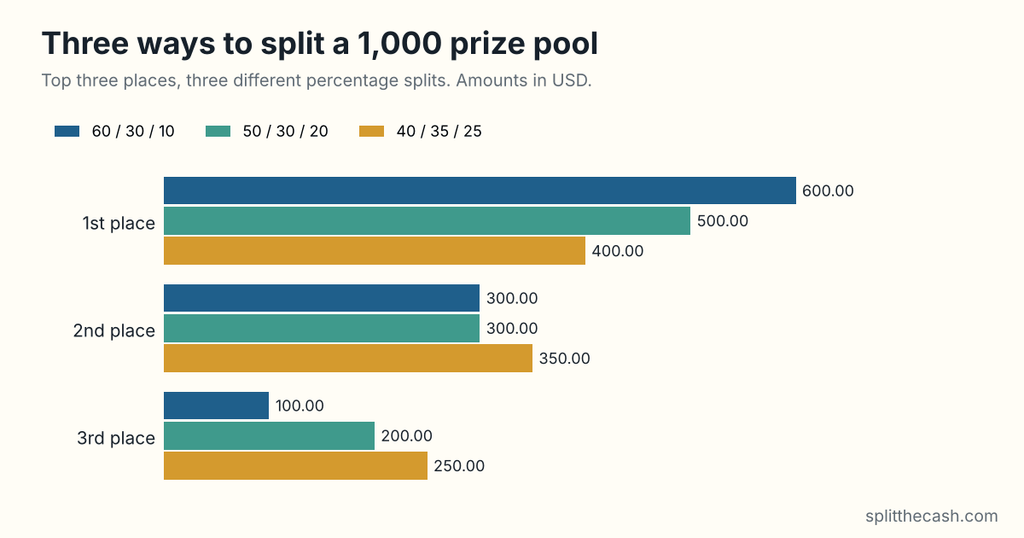
If more places are paid, give each place a smaller share than the one above it, and check the total is 100%. Some example splits:
| Places paid | Example split (%) |
|---|---|
| 2 | 65 / 35 |
| 3 | 50 / 30 / 20 |
| 4 | 40 / 30 / 20 / 10 |
| 5 | 35 / 25 / 18 / 13 / 9 |
These are examples, not rules. A fantasy football league or a footy tipping competition works the same way: agree the places and percentages when people pay in, not at the end of the season.
How to split prize money 3 ways
If three people share the prize equally, divide by three and round to the cent so the parts still add up to the total. 1,000 split three ways is 333.34, 333.33 and 333.33: one person gets the extra cent. The equal split calculator handles the leftover cents for any number of people.
What happens when places are tied
The usual rule, used on the PGA Tour, is to add up the prizes for all the places the tied players cover and divide the total equally between them (Golf News Net). Two players tied for second don’t share second place’s prize alone; they share second and third.
Example: a 2,000 USD pool paid 40/30/20/10 gives 800, 600, 400 and 200. If two players tie for second, they share 600 + 400 = 1,000, so each gets 500. First still gets 800 and fourth 200.
Try it: the calculator below has the tie already entered, with the two tied players at 25% each. Change the pool, the places or the percentages.
Splitting prize money within a team
Most teams split equally: a quiz team of five that wins 300 GBP takes 60 each. When some players took part more than others, split by matches or rounds played instead, but agree that before the competition starts.
Example: a team wins 1,200 EUR. Ana and Ben played 6 matches each, Chloe 5, Dan 4 and Ella 3. Split by matches, they get 300, 300, 250, 200 and 150; split equally, 240 each. In the prize money calculator, choose “By points” and enter the matches each person played. To give everyone a fixed amount first, for example 100 each, and share the rest by percentage, choose “Fixed + percentage”.
How a lottery syndicate splits a win
In a syndicate, one person (the organiser) buys the tickets with everyone’s money. In the UK, the lottery operator sees only the organiser as the ticket holder; the organiser receives any prize and has agreed to share it with the members, which creates a contract between them. A syndicate of friends or colleagues needs no licence (Gambling Commission).
The fair split is in proportion to what each member paid in for that draw. Example: an office syndicate wins 1,250 GBP. Amy paid 8, Ben and Chloe 4 each, Dan and Ella 2 each (20 in total). Amy gets 500, Ben and Chloe 250 each, Dan and Ella 125 each. Split equally, everyone would get 250, and Amy would lose 250 of her share.
Write the rules down before the first draw:
- who is in, and how much each pays per draw;
- how a win is split: equally, or by what each paid in;
- what happens if someone hasn’t paid for a draw (for example, no share of that draw);
- who buys and keeps the tickets, and how members can check the numbers;
- what happens to small wins: paid out, or used for the next tickets.
Common questions
How do I divide prize money between 1st, 2nd, 3rd, 4th and 5th?
Choose five percentages that fall from first to fifth and add up to 100%, for example 35, 25, 18, 13 and 9, and multiply the pool by each. On a 1,000 pool that is 350, 250, 180, 130 and 90.
Should fees come off before the split?
Yes. Take off any entry costs, venue fees or the organiser’s agreed expenses first, then split what is left.
What is the best way to split lottery winnings with family?
The same way as any syndicate: by what each person paid towards the ticket, unless you agreed something else beforehand. Giving money away after a win is a different matter from sharing a prize you won together, and tax rules may treat the two differently, so check the rules where you live. In the US, when a group shares a winning ticket, the members fill in a form that the payer uses to issue tax forms to each person who shares the prize (IRS Form 5754).
How do professional events like golf majors split prize money?
Each event publishes its own payout table, so check the event’s announcement. The tie rule above is how the PGA Tour handles players finishing level.
How do I share the result with the group?
Enter the split in the prize money calculator and create a link to share. Everyone sees the same amounts and how they were worked out.