
There is no single fair way to split a team bonus. There are four common rules: equal parts, by salary, a mix of both, or agreed percentages. Each one is fair for a different reason. The most important step is to choose the rule before anyone sees the amounts, and to tell the team which rule you used.
Below, the same bonus pool is split all four ways so you can compare the results side by side. You can try your own numbers in the calculator at the end.
The example
A team of four shares a bonus pool of 10,000 EUR. Their monthly salaries are:
| Person | Monthly salary |
|---|---|
| Anna | 4,200 |
| Ben | 3,500 |
| Chris | 3,000 |
| Dana | 2,800 |
| Total | 13,500 |
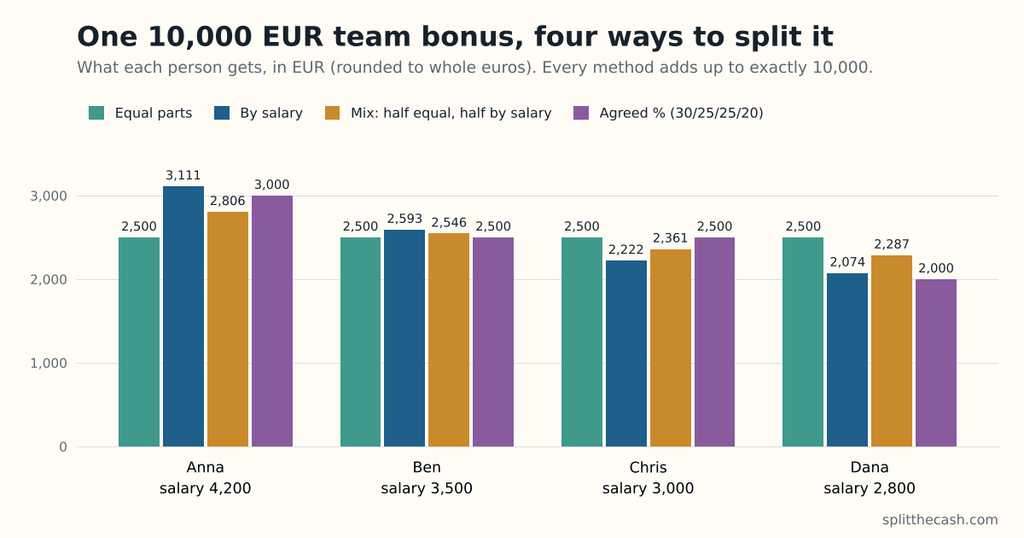
1. Equal parts
Everyone gets the same amount: 10,000 ÷ 4 = 2,500 EUR each.
When it feels fair: the bonus rewards a shared result, such as a project delivered or a target the whole team reached, and everyone contributed in a similar way. It is also the simplest rule to explain.
When it doesn’t: people with bigger roles or longer hours may feel their extra work counted for nothing.
Split money equally calculator
2. By salary
Each person gets a share of the pool in proportion to their salary. The formula is:
Person’s bonus = pool × their salary ÷ total salaries
For Anna: 10,000 × 4,200 ÷ 13,500 = 3,111.11 EUR.
| Person | Share | Bonus |
|---|---|---|
| Anna | 31.11% | 3,111.11 EUR |
| Ben | 25.93% | 2,592.59 EUR |
| Chris | 22.22% | 2,222.22 EUR |
| Dana | 20.74% | 2,074.08 EUR |
| Total | 10,000.00 EUR |
Dana’s exact share is 2,074.074… EUR. Rounding every share down would leave one cent unassigned, so that cent goes to the person whose exact share was closest to the next cent, which is Dana. This way the parts always add up to exactly 10,000.
When it feels fair: salaries already reflect responsibility and experience, and the bonus is seen as an extra part of pay. Everyone gets the same percentage of their salary, here about 74% of one month’s salary each.
When it doesn’t: the gap between the highest and lowest paid grows. Here Anna gets 1,037.03 EUR more than Dana, although the team reached the result together.
Bonus split calculator by salary
3. Mix: half equal, half by salary
Part of the pool is shared equally and the rest by salary. With a 50/50 mix, 5,000 EUR is split equally (1,250 each) and 5,000 EUR by salary.
| Person | Equal part | By salary | Bonus |
|---|---|---|---|
| Anna | 1,250.00 | 1,555.55 | 2,805.55 EUR |
| Ben | 1,250.00 | 1,296.30 | 2,546.30 EUR |
| Chris | 1,250.00 | 1,111.11 | 2,361.11 EUR |
| Dana | 1,250.00 | 1,037.04 | 2,287.04 EUR |
| Total | 5,000.00 | 5,000.00 | 10,000.00 EUR |
The gap between Anna and Dana is now 518.51 EUR, half of what it was with the salary split.
When it feels fair: you want to recognise that everyone contributed to the shared result, while still reflecting different roles. It is a common compromise when people disagree about equal versus by salary. You can change the balance, for example 70% equal and 30% by salary.
Bonus calculator: half equal, half by salary
4. Agreed percentages
The team or the manager agrees a percentage for each person, for example based on a performance review or on who led which part of the work. Suppose the agreed shares are 30%, 25%, 25% and 20%:
| Person | Agreed share | Bonus |
|---|---|---|
| Anna | 30% | 3,000 EUR |
| Ben | 25% | 2,500 EUR |
| Chris | 25% | 2,500 EUR |
| Dana | 20% | 2,000 EUR |
When it feels fair: contributions were clearly different and the team accepts how the percentages were set. The percentages must add up to 100%.
When it doesn’t: if nobody knows how the percentages were decided, this rule causes the most arguments. Write down the reasons.
Bonus split by percentage calculator
What about part-time staff and people who joined mid-year?
If people worked very different amounts of time, splitting by hours or days worked is often fairer than by salary. Suppose Anna and Ben worked 160 hours, Chris 120 and Dana 80:
| Person | Hours | Bonus |
|---|---|---|
| Anna | 160 | 3,076.93 EUR |
| Ben | 160 | 3,076.92 EUR |
| Chris | 120 | 2,307.69 EUR |
| Dana | 80 | 1,538.46 EUR |
Anna and Ben worked the same hours but differ by one cent: 10,000 cents can’t be split into four exact shares here, so one extra cent goes to the first person in the list. For someone who joined halfway through the year, you can use days worked in the same way. In the calculator, choose “By salary” and then switch “Split according to” to Hours worked or Days worked.
Tips to avoid arguments
- Agree the rule first. Choosing a rule after seeing who gets what always looks like it was picked to favour someone.
- Use one rule for everyone. Exceptions for single people are what usually start disputes.
- Show the calculation. A short table like the ones above, shared with the team, answers most questions before they are asked.
- Split the gross amount. Tax on bonuses depends on the country and on each person’s situation, so split the pool before tax and let payroll handle the rest. Check your local rules if you’re unsure.
Try it with your own numbers
The calculator below starts with the example above, using the 50/50 mix. Change the amount, the names and the salaries, or pick another method. It runs in your browser: nothing you type is sent or stored. When you’re done, you can share the result with your team using a link.
Common questions
Which method is the fairest?
None is fair in every case. Equal parts rewards the team result, salary rewards responsibility, percentages reward individual contribution, and the mix balances team and role. Pick the one that matches why the bonus was paid.
How should a team bonus be structured?
Settle four things, in this order, and write them down:
- The size of the pool. A fixed amount, or a share of profit or sales, for example 5% of the year’s profit.
- Who qualifies. For example, everyone employed on the last day of the year, or everyone who worked at least three months.
- The splitting rule. One of the methods above, chosen before the amounts are known.
- When it is paid. A fixed date or month, so nobody has to ask.
Is a 6% bonus good? Is a 2% bonus normal?
There is no single answer. What counts as a good or normal bonus varies a lot by country, industry, role and company, so be wary of any one figure presented as the rule. It helps to turn the percentage into time. If the bonus is a percentage of yearly salary:
| Bonus as % of yearly salary | About the same as |
|---|---|
| 2% | 1 week of pay |
| 6% | 3 weeks of pay (0.7 of a month) |
| 8.3% | 1 month of pay |
In the example above, the 10,000 EUR pool split by salary gives each person about 6.2% of their yearly salary. To judge whether a percentage is good for you, compare it with what your contract or company policy promised, with what you received in earlier years, and with how well the company or team did that year.
Should a bonus be paid separately from salary?
Many employers show the bonus as a separate line on the payslip, or pay it as a separate payment, so it’s clear what is regular salary and what is a one-off. Whether it is taxed differently from salary depends on the country, so ask your payroll provider or accountant how bonuses are handled where you are. For splitting the pool, it makes no difference: split the gross amount first, then let payroll apply tax to each person’s share.
Why don’t the amounts come out round?
Most splits don’t divide evenly to the cent. The calculator rounds each share to the cent and gives any leftover cents to the people whose exact shares were closest to the next cent, so the total always matches the pool exactly.
Can I use this for tips or commission?
Yes. The same rules apply to any shared pool of money. For tips shared by hours worked, see the tip pool calculator. For one client payment shared by the people who did the work, see the shared job payment calculator.